_PNG.png)
How Botanist of the Valley Transformed a Backyard Vision Into a Private Arizona Resort
- Jul 16
- 6 min read
A major backyard transformation can feel overwhelming, especially when homeowners know how they want the space to feel but are unsure how every individual feature should come together.
That was the situation for the homeowners featured in our latest client testimonial.
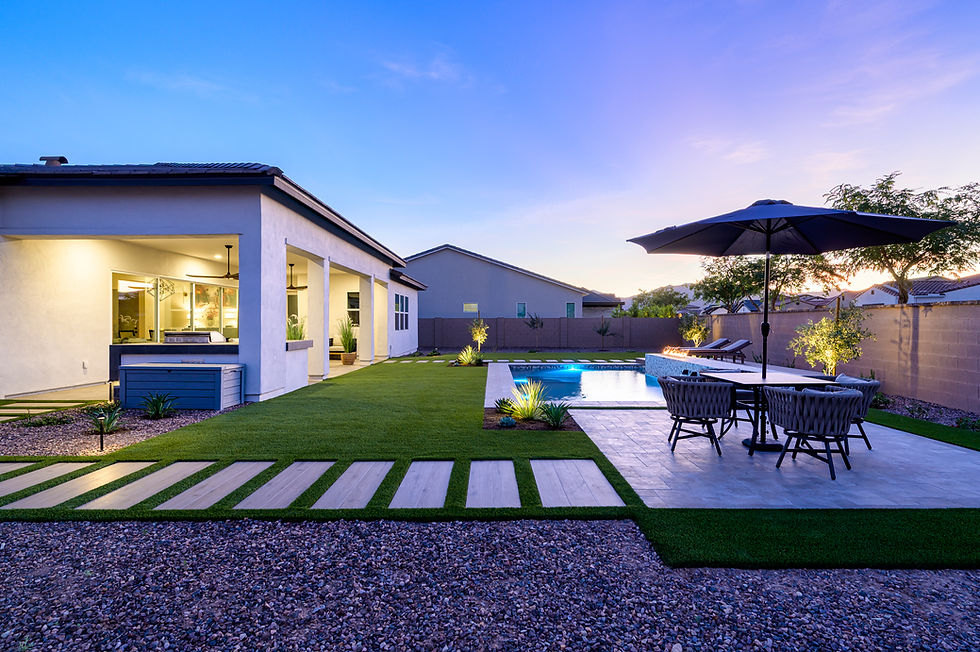
They had previously installed a pool at another home, but this was their first backyard project of this scale. The goal was not simply to add a pool or make a few cosmetic improvements. They wanted to create a complete outdoor-living environment where they could swim, cook, entertain, relax, and enjoy Arizona evenings at home.
The result is a backyard they now describe as their “own little resort.”
Watch Youtube video above
A Backyard Project Larger Than Anything They Had Done Before
The homeowners had completed a pool project in North Carolina, but they explained that this Arizona backyard was a much larger undertaking.
The new project brought together several areas of outdoor living into one cohesive design, including:
A custom pool
An integrated fire feature
An outdoor kitchen and grilling area
Covered patio seating
Artificial turf
Modern stepping-stone walkways
Landscape lighting
Low-maintenance desert planting
Multiple areas for gathering and relaxing
Rather than treating each feature as a separate addition, the design needed to make the entire property feel connected.

Why the Homeowners Chose Botanist of the Valley
Before selecting Botanist of the Valley, the homeowners met with several different companies.
Their decision came down to more than a list of features or a construction estimate. They wanted to feel confident that the company understood the size of the project and could guide them through the process.
As they explained in the testimonial:
“We did a few interviews with different companies. It wasn’t even close. We felt so comfortable with Botanist.”
From the initial meeting, the homeowners felt that the relationship was personal rather than transactional. They described Marty as approachable, creative, and someone who took the time to understand them before presenting a design.
That early connection became an important part of the project because the homeowners did not arrive with every detail already decided.
They had ideas, but they needed a designer who could turn those ideas into a complete vision.
Designing Around the Homeowners, Not Just the Backyard
One of the most memorable moments from the interview came when the homeowner said he did not initially realize Marty was “sizing them up.”
Out of context, that phrase may sound unusual. What he meant was that Marty was paying attention to the homeowners’ style, personalities, existing home, colors, and the way they wanted to use the property.
The homeowner explained:
“He got an idea of what we liked just by hanging out with us for a little bit.”
This is an important part of a design-led process.
Many homeowners can describe activities they want to enjoy outside, but they may not know:
How large each space should be
Which materials should be repeated
How the pool should relate to the patio
Where the outdoor kitchen should be located
How walkways should move through the yard
Which features should become focal points
How lighting will affect the space at night
A designer’s job is not simply to ask the homeowner to choose from a catalog. It is to interpret their goals and create a space that feels natural for them.
When the homeowners later saw the proposed design, they felt it reflected their preferences accurately.
“He nailed it. He was 100 percent accurate. He had the colors and the design nailed.”

Why 3D Design Matters Before Construction Begins
A detailed 3D design allows homeowners to experience the project before major construction decisions are finalized.
Instead of trying to imagine the finished backyard from separate plans, material samples, and conversations, homeowners can see how the pool, hardscape, structures, landscaping, and furniture work together.
For this project, the initial design remained very close to what was ultimately constructed.
The homeowners said:
“We changed very little of what he drew for us initially.”
That does not mean a design can never change. Adjustments may still be made for budget, dimensions, engineering, construction conditions, or homeowner preferences.
However, starting with a clear visual plan helps reduce uncertainty and gives the homeowner and construction team a shared direction.

Communication Made the Construction Experience Different
Large outdoor-living projects involve multiple phases, trades, materials, inspections, and scheduling decisions. Even when the final result is beautiful, poor communication can make the construction period unnecessarily stressful.
For these homeowners, communication became one of the most noticeable differences between Botanist of the Valley and their previous experience with another pool project.
They explained:
“They always let us know when they were going to be here and when they weren’t going to be here.”
They also appreciated having multiple points of contact and knowing that someone was available when they had questions.
“What they told us was exactly what they did.”
Consistent communication does not eliminate every challenge that can occur during construction. It does, however, help homeowners understand what is happening, what comes next, and how decisions are being addressed.
Attention to Details the Homeowners May Never Have Noticed
The homeowners also described watching the team redo portions of the project that already looked acceptable to them.
From their perspective, the work looked beautiful. However, the construction team identified details that did not meet its own standards and chose to correct them.
One example involved the finishing around the pool tile.
The homeowner remembered seeing a worker hand-file the tile corners rather than leaving rough or unfinished edges.
“It’s not like it’s just slapped together. It is workmanship.”
This kind of detail may not always be obvious in a wide photograph, but it affects how the project looks and feels in person.
Craftsmanship often appears in the areas most people do not notice immediately:
Tile transitions
Finished corners
Alignment between materials
Grout and joint consistency
Coping details
Paver layout
Edges around structures
The way outdoor features meet one another
A luxury outdoor space should not only look impressive from across the yard. It should also feel thoughtfully finished when the homeowner experiences it up close.

Solving Construction Details as They Arise
The homeowners did not describe the project as completely free of decisions or adjustments.
One detail arose where the grill area met a structural post. The alignment was not where the team wanted it to be, even though the homeowners said they may not have noticed the issue themselves.
Rather than ignoring the concern, the team presented possible solutions and corrected the detail.
The homeowners summarized the experience simply:
“They made it right.”
That approach is important on custom projects because some details can only be fully evaluated as construction progresses.
What matters is whether the concern is recognized, communicated, and resolved in a way that protects the overall design.
A Backyard That Changed How They Use Their Home
The strongest measure of a successful outdoor-living project is not how it looks on the day photography is completed. It is how the homeowners use it afterward.
The couple now spends more time outside swimming, cooking, relaxing, and enjoying the Arizona weather.
They described a typical evening as:
Spending time in the pool
Bringing their dog outside
Sitting together near the water
Watching the sunset
Turning on the fire feature
Enjoying a cup of coffee outside
The project created an everyday destination without requiring them to leave home.
Their friends and family have had a similar reaction.
“They’re like, ‘Oh my gosh. This is absolutely gorgeous.’”
For the homeowners, the transformation feels larger than the individual pool, kitchen, patio, or landscaping features.
“It’s like having our own little resort back there.”
What Other Homeowners Can Learn From This Project
Homeowners do not need to arrive at the first design meeting knowing every material, measurement, or construction detail.
A productive starting point is understanding how the backyard should support everyday life.
Consider questions such as:
Who will use the space most often?
Will the backyard be used primarily for entertaining or relaxing?
Is outdoor cooking important?
Should the pool be the main visual focal point?
How will the space be used during the day and at night?
Are shade and cooling features priorities?
What should guests experience when entering the yard?
Which parts of the existing home should influence the design?
Which maintenance responsibilities should be minimized?
The design team can then translate those answers into the layout, scale, materials, and features that form the complete project.
Start With the Experience You Want to Create
The homeowners in this testimonial did not need to know everything about backyard design before beginning.
They needed a team that would listen carefully, understand their style, show them the possibilities, and guide the project from design through construction.
Their finished backyard now gives them a place to swim, cook, gather, enjoy the sunset, and relax around the fire—all within a space designed specifically around their home and lifestyle.
As they reflected at the end of the interview:
“He came up with things that we would not have thought of. It came out great. It really did.”
Planning an Arizona Backyard Transformation?
Botanist of the Valley designs and builds custom outdoor-living spaces throughout the Phoenix area, including pools, landscapes, outdoor kitchens, fire features, shade structures, lighting, and complete backyard transformations.
Ready to explore what your backyard could become? Schedule a consultation with Botanist of the Valley to begin developing a design centered around your home, lifestyle, and vision.


Comments