_PNG.png)
4 Popular Pool Shapes for Arizona Backyards: Which One Is Right for You?
Choosing a pool shape may seem like one of the simpler decisions in a backyard design. In reality, the shape of your pool influences almost everything around it.
It can affect how much usable swimming space you have, where people gather, how the pool relates to the house, how much patio space remains, where an attached spa makes sense, and even how landscaping and shade structures fit into the finished backyard.
For Arizona homeowners, that decision becomes even more important because a pool is rarely an isolated feature. It often becomes the centerpiece of a larger outdoor living environment that may include a Baja shelf, spa, outdoor kitchen, fire feature, pergola, landscape lighting, planting and entertainment areas.
At Botanist of the Valley, we approach the pool as part of the complete property rather than designing it separately from everything around it. Our existing custom pool design process considers pool shape, built-in features, finishes and how each element contributes to the way the space will ultimately be used.
Below, we're comparing four popular swimming pool shapes and the types of properties and lifestyles each one tends to complement best.

1. Rectangular Pools: Clean, Modern and Versatile
The rectangular pool is one of the most recognizable swimming pool shapes, and there is a reason it continues to work across so many different architectural styles.
A traditional rectangular pool uses four straight sides and a simple, symmetrical footprint. That simplicity makes it extremely versatile.
For contemporary homes, the straight lines can reinforce the architecture of the house. For more traditional properties, the same basic shape can be softened through landscaping, coping selections, water features and surrounding materials.
Rectangular pools are also especially practical when swimming is an important part of how the homeowner intends to use the space. The long, uninterrupted swimming area works naturally for laps, recreation and exercise without requiring an oversized footprint.
Why Choose a Rectangular Pool?
One of the biggest advantages is how efficiently the shape uses space.
If you're working with a relatively narrow backyard, a rectangle can run parallel to the house or property line while preserving usable areas for walkways, landscaping and furniture.
It also works particularly well with popular pool features such as:
Baja shelves, integrated spas, benches, automatic pool covers, raised bond beams and modern water features can all be incorporated without disrupting the clean overall geometry.
The simplicity also gives the surrounding landscape more freedom. The pool doesn't have to be the most complex feature in the yard. Instead, the outdoor kitchen, pergola, fire feature or planting can become the focal point.

When a Rectangular Pool Works Best
A rectangular design is especially worth considering when the home has strong architectural lines, the property is relatively narrow, lap swimming matters, or you want the backyard to have a modern and organized appearance.
It is also a strong starting point for homeowners who prefer minimalism.
That doesn't mean rectangular pools have to feel basic.
Premium coping, glass tile, integrated spas, infinity edges, water features and sophisticated lighting can completely transform the appearance while maintaining the clean underlying geometry.
Designer Tip
Look beyond the pool itself and consider what the long axis of the rectangle is pointing toward.
A pool can visually lead your eye toward a mountain view, architectural feature, fire element or landscape focal point. Sometimes simply rotating the same pool creates an entirely different experience.
Explore more examples of custom pool and outdoor living environments in the Botanist of the Valley project gallery.
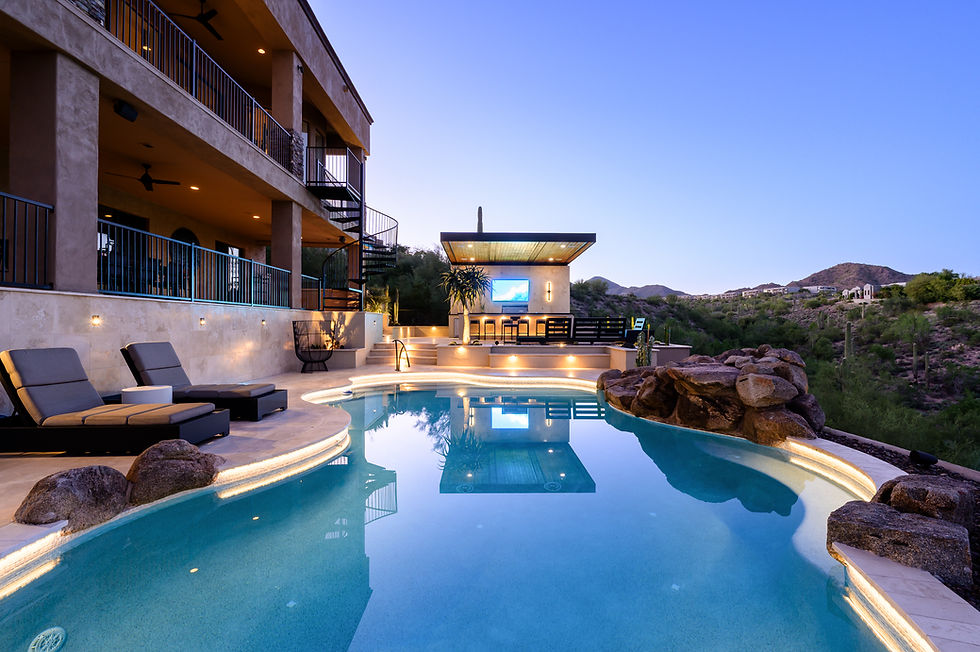
2. Freeform Pools: Organic and Resort-Inspired
A freeform pool takes nearly the opposite approach.
Instead of relying on rigid straight lines, freeform swimming pools use flowing curves and irregular edges to create a softer, more organic appearance.
They can be particularly effective when the goal is to make the pool feel integrated into the landscape rather than visually separated from it.
For that reason, freeform pools often appear in resort-inspired backyards.
Curving edges create natural opportunities for landscaping, boulders, palms, desert planting, waterfalls and other features that make the pool feel as though it belongs within the environment.

Why Choose a Freeform Pool?
One of the greatest advantages of freeform pool design is flexibility.
The pool can respond to the property rather than forcing the property to respond to the pool.
For example, a curve can help navigate around an existing patio, preserve a tree, transition around an outdoor living area or create a separate pocket for a Baja shelf.
The irregular shape also makes it easier to create distinct visual areas within the same pool.
One portion might become a shallow lounging area. Another could provide deeper swimming space. A curved section might wrap around a spa or landscape feature.
The result can feel less formal than a rectangular pool and more like a destination within the backyard.
When a Freeform Pool Works Best
Freeform pools are worth considering for homeowners who want a relaxed, organic or resort-style backyard.
They also work particularly well when the landscape itself is a major part of the design.
Instead of surrounding the pool with hardscape on every side, portions of the edge can interact visually with planting, decorative rock or other natural materials.
Botanist's broader approach to Arizona outdoor living emphasizes planning the pool, landscape, shade, hardscape and gathering areas as one environment rather than treating each feature independently.
You can explore that process in our Complete Guide to Designing an Outdoor Living Space in Arizona.
Designer Tip
If you're choosing a freeform pool because you want a natural appearance, carry that design language into the rest of the yard.
A heavily curved pool surrounded entirely by rigid square patios and disconnected planting beds can feel inconsistent.
Instead, consider how planting, boulders, pathways and gathering areas can reinforce the movement created by the pool.
3. L-Shaped Pools: Create Multiple Zones in One Design
An L-shaped pool combines two rectangular sections at approximately a right angle.
While the shape itself is relatively simple, it can be extremely useful for creating separate functions within the same swimming pool.
This makes the L-shaped pool particularly interesting for families and homeowners who want their pool to serve more than one purpose.

Why Choose an L-Shaped Pool?
The primary advantage is zoning.
Imagine the longer portion of the pool functioning as the primary swimming area while the shorter section becomes a shallow Baja shelf.
Or the secondary section could house an attached spa.
Another design might use one portion for lap swimming while keeping the other area shallower for children and casual recreation.
The L-shape can also respond naturally to the architecture of a home.
If a covered patio, casita or wing of the house projects into the backyard, the pool can sometimes wrap around that architecture instead of sitting completely separate from it.
That can make the pool feel more connected to the home.
When an L-Shaped Pool Works Best
This shape tends to work best when the property has enough room for both sections to feel intentional.
It can be particularly effective for larger backyards, homes with multiple outdoor areas or families wanting separate swimming and lounging zones.
However, adding another section simply to make the pool appear more interesting isn't necessarily better.
Each portion of the L should have a reason to exist.
Designer Tip
Think about circulation before deciding where the second leg should extend.
Where will people walk when leaving the house?
Where will the lounge chairs go?
How will someone travel between the pool, outdoor kitchen and covered patio?
How will you access the spa?
The most successful L-shaped designs use the shape to solve those questions instead of creating additional obstacles.
4. Geometric Pools: Custom Shapes Designed Around the Architecture
A geometric pool is a broader category that uses intentional straight lines, angles, squares, rectangles and offsets to create a customized architectural composition.
A geometric swimming pool may start with a rectangle, but it doesn't have to remain one.
Sections can extend outward to create shallow areas. An attached spa might intersect the main pool. Steps can project from one edge. An offset section might align with an outdoor kitchen or patio.
This flexibility makes geometric pools particularly well suited to contemporary custom homes and larger outdoor living projects.
Botanist of the Valley currently identifies custom geometric pools as one of its core pool specialties, alongside other luxury pool and outdoor-living designs.

Why Choose a Geometric Pool?
A geometric pool allows the architecture to dictate the design.
Lines from the home can continue into the pool.
A patio edge can align with a Baja shelf.
The centerline of a window or sliding door can line up with a water feature.
An attached spa can become an architectural element rather than simply an accessory added to one corner.
This approach is especially effective when the pool is visible from important interior spaces.
Remember that you'll spend a significant amount of time looking at the pool from inside the house—not only swimming in it.
A well-planned geometric design can frame that view intentionally.
When a Geometric Pool Works Best
Consider a geometric pool if your home has contemporary architecture, you want something more customized than a basic rectangle, or the complete backyard design includes multiple architectural elements that should visually relate to one another.
Geometric pools also pair particularly well with modern edge treatments, premium hardscape and integrated fire or water features.
Designer Tip
The more complicated the geometry becomes, the more valuable visualization becomes.
Looking at several rectangles on a 2D plan doesn't always communicate how the finished space will feel.
Botanist uses scaled 2D and 3D design to allow homeowners to evaluate the pool together with the house, hardscape, landscape and surrounding outdoor areas before construction.
That allows major changes to happen on the screen rather than after concrete has already been placed.
Rectangular vs. Freeform vs. L-Shaped vs. Geometric Pools
There isn't one universally correct pool shape.
A rectangular pool often provides the cleanest architecture and efficient swimming space. A freeform pool creates a softer, more organic environment. An L-shaped pool can create functional zones, while a custom geometric pool offers greater freedom to respond directly to the architecture and complete backyard plan.
The better question isn't:
"Which pool shape looks best?"
It's:
"Which shape works best for this property and the way we're going to use it?"
Pool Shape | Often Works Well For | Visual Character | Primary Advantage |
Rectangular | Modern homes, swimming, narrower lots | Clean and architectural | Efficient usable space |
Freeform | Resort landscapes, irregular yards | Organic and relaxed | Blends into landscaping |
L-Shaped | Families and larger properties | Structured and functional | Creates separate zones |
Geometric | Custom homes and luxury projects | Modern and customized | Responds closely to architecture |
Does Pool Shape Affect the Cost of Building a Pool?
Yes, but shape alone usually doesn't tell you what a pool will cost.
Two pools with similar footprints can have very different construction costs depending on perimeter, overall surface area, depth, site access, engineering and selected features.
A simple rectangle with an integrated spa, premium waterline tile, upgraded interior finish, heating, automation and extensive water features could easily become a more substantial project than a relatively simple freeform pool.
Likewise, additional perimeter, structural complexity and specialty edge conditions may affect construction requirements.
That is why we recommend thinking about the pool as a complete system rather than choosing a shape based primarily on an assumed price category.
If you're researching the entire process—not only the shape—our guide to the pool building process in Phoenix explains how design, engineering, permitting and construction fit together. Botanist notes that Arizona projects also have to account for factors such as desert soil, intense sun, HOA requirements and municipal permitting.
Don't Confuse Pool Shape With Pool Edge
One distinction homeowners sometimes overlook is the difference between the shape of the pool and the edge condition.
Rectangle, freeform, L-shaped and geometric describe the basic footprint.
Infinity edges, knife edges, grass edges, acrylic walls and other treatments describe what happens where the water meets the surrounding environment.
That means you could have:
A rectangular infinity pool.
A geometric knife-edge pool.
A freeform pool with natural rock along part of the perimeter.
The decisions work together, but they aren't the same thing.
If you're comparing those options, read our complete guide to 7 Types of Pool Edges: Pros, Cons & Design Ideas. The guide covers pebble, landscaped, natural rock, knife, acrylic, infinity and grass-edge conditions and explains how maintenance, architecture, circulation and the complete hydraulic system should factor into the decision.

How 3D Design Helps You Choose the Right Pool Shape
This is one of the areas where 3D landscape design becomes especially useful.
Imagine you're deciding between a rectangular pool and a freeform design.
On paper, both may technically fit.
In 3D, however, you can begin asking much more useful questions.
What do you see when you open the back door?
Does the pool block circulation to the outdoor kitchen?
Is there enough room behind the Baja shelf for lounge chairs?
Does the spa feel connected to the entertainment area?
Is the pool visually aligned with the architecture?
Where does afternoon shade fall?
Does one design preserve more usable landscape area?
These are difficult questions to answer from dimensions alone.
Botanist's design process uses scaled visualization to help homeowners review layouts and make revisions before construction begins.
The goal isn't simply to produce an attractive rendering.
It's to make better decisions while those decisions are still inexpensive to change.
What Else Should You Consider Before Choosing a Pool Shape?
The pool is only one part of the property.
Before committing to a shape, consider how it interacts with the house, patio doors, property setbacks, existing grades, views, utilities, drainage, shade structures, outdoor kitchen, fire features, landscaping, equipment location and the paths people will naturally take through the backyard.
This is particularly important when you're planning a full outdoor living project.
A beautiful pool can still create a frustrating backyard if it leaves nowhere comfortable to put furniture or forces everyone to squeeze through a narrow walkway to reach the outdoor kitchen.
Conversely, a relatively simple pool shape can feel exceptional when everything around it is thoughtfully coordinated.
That is why Botanist's broader design-build approach considers the pool, landscape, hardscape, shade, lighting, irrigation and gathering spaces together.
Frequently Asked Questions About Pool Shapes
What is the most popular swimming pool shape?
Rectangular and other geometric pool shapes remain common because they're versatile, work with many architectural styles and provide efficient swimming space. Freeform pools are also popular for homeowners looking for a softer, resort-inspired backyard. The most appropriate option depends on the property and how the homeowner intends to use the space.
What pool shape works best for a small backyard?
A simple rectangular or compact geometric pool often works well because straight edges can make efficient use of limited space. However, property dimensions, setbacks, access and the surrounding patio should be considered before selecting a final shape.
Are rectangular pools less expensive than freeform pools?
Not necessarily. Pool construction costs depend on much more than whether the edge is straight or curved. Perimeter, surface area, depth, structural requirements, equipment, finishes, decking, site access and additional features all influence the final project cost.
What pool shape works best with a Baja shelf?
Baja shelves can be incorporated into rectangular, freeform and geometric pools. Rectangular and geometric designs can create very clean shelf transitions, while freeform pools allow the shelf to become part of a softer, curved composition.
What pool shape works best for a modern Arizona home?
Rectangular and custom geometric pools frequently complement modern architecture because their straight lines can align with the home's walls, windows and hardscape. Materials, edge conditions and landscape design also play a major role in determining whether the finished pool feels contemporary.
Can I combine straight and curved sections in one pool?
Yes. Custom pool designs don't have to fit neatly into one category. A design can combine geometric areas with curved sections when that approach makes sense for the architecture, property and intended use.
Can I see different pool shapes before deciding?
Yes. 3D landscape design can be used to compare different pool layouts from similar viewpoints, allowing you to evaluate how each option relates to the house and surrounding outdoor living spaces before construction.
Which Pool Shape Is Right for Your Arizona Backyard?
Choosing among different pool shapes isn't about finding the design that looks the most impressive on social media.
It's about finding the one that makes sense for your home, your property and the way you intend to live outside.
A rectangle might create the perfect relationship with a modern home.
A freeform pool might soften a heavily landscaped resort-style backyard.
An L-shaped design might give a growing family separate recreation zones.
A custom geometric pool might be the best way to connect several architectural elements into one cohesive outdoor environment.
At Botanist of the Valley, we design custom pools as part of the complete backyard. Through thoughtful planning and immersive visualization, homeowners can evaluate their pool, spa, hardscape, landscaping, shade and gathering areas together before construction begins.

Ready to explore pool shapes and backyard ideas for your property?
Or browse the Botanist of the Valley project gallery for more custom pool and outdoor living inspiration.


Comments