_PNG.png)
How to Plan Landscape Design in Phoenix: A Complete Guide for Arizona Homeowners
Designing a backyard in Phoenix requires a different approach than designing an outdoor space in many other parts of the country.
The intense sun, long periods of heat, limited rainfall, desert soils and year-round potential for outdoor living all influence how a property should be planned. A beautiful backyard may photograph well, but if the patio receives intense afternoon sun, the plants struggle in their exposure, or people have to squeeze around the pool to reach the outdoor kitchen, the design may not work particularly well in everyday life.
Good landscape design in Phoenix is about much more than selecting plants.
It involves deciding how people will move through the property, where shade is needed, how the pool relates to the house, where entertaining will happen, what materials make sense for the project, how irrigation will operate, and what the landscape should look like several years after installation.
At Botanist of the Valley, we approach those decisions as parts of one complete outdoor environment. The pool, landscape, hardscape, shade structures, lighting, irrigation and gathering spaces should work together rather than feeling like separate projects added over time. Botanist's current Phoenix service page reflects that same design-build approach across pool construction, landscape design, shade, hardscape and complete backyard transformations. Botanist of the Valley

Start With How You Want to Use the Backyard
One of the easiest mistakes to make during a backyard remodel is starting with products instead of people.
Homeowners often begin with questions such as:
What pool shape should we use?What pavers should we choose?Which plants should we install?
Those decisions matter, but they usually shouldn't be the first questions.
A better starting point is understanding how the property needs to function.
A family that regularly hosts 20 people needs a very different layout from a couple who wants a quiet place to have coffee in the morning. A family with young children may prioritize swimming, lawn and visibility across the property. Empty nesters may care more about shade, low-maintenance planting and intimate seating areas.
Even homes with nearly identical lots can require completely different designs.
Before developing a residential landscape design in Phoenix, think about how often you entertain, which times of day you spend outside, whether children or pets will use the property, how much maintenance you are comfortable with, and whether the backyard needs to support dining, swimming, cooking, recreation or quiet relaxation.
Botanist discusses this same philosophy in our article about the outdoor-living design process: the conversation should begin by understanding the homeowner rather than immediately deciding where every feature belongs. Botanist of the Valley
[IMAGE PLACEHOLDER — Botanist designer meeting with homeowners or walking a property during consultation]
Phoenix Landscape Design Should Consider the Sun Before Almost Anything Else
Sun exposure can dramatically change how comfortable different areas of the same backyard feel.
A space that looks ideal on a plan may become difficult to use if it receives direct western sun during the time of day when the homeowner actually wants to sit outside.
That makes orientation important early in the design process.
When planning a Phoenix backyard, we want to think about where the house casts shade, which areas receive afternoon exposure, how a shade structure might affect the space, where trees can provide useful canopy, and whether the primary gathering areas make sense for the family's schedule.
This doesn't mean every outdoor space should be shaded.
Morning areas may benefit from sun during cooler months. Pools typically need a different strategy than dining areas. Plant material also responds differently depending on its exact exposure.
The goal is to understand those relationships before permanent features dictate the layout.
Botanist's location content specifically considers sun orientation, reflected heat, shade, planting exposure and microclimates as factors that can influence how an Arizona backyard performs. Botanist of the Valley
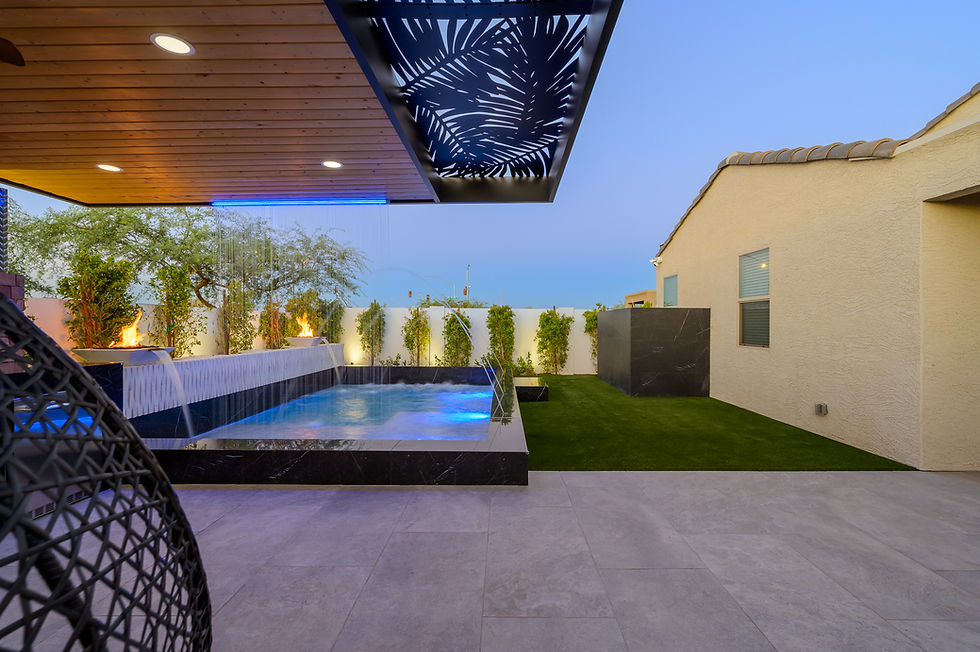
Shade Should Be Part of the Original Plan
In Phoenix, shade shouldn't feel like something added after the rest of the landscape is finished.
It should be part of the architecture of the backyard.
That shade could come from a covered patio, pergola, ramada, strategically positioned trees or a combination of structural and natural elements.
Placement matters just as much as the structure itself.
A pergola placed where nobody naturally gathers won't solve much. A beautiful outdoor kitchen that has no protection from late-afternoon exposure may be used less often than expected. A pool lounge area without appropriate shade options can become uncomfortable during the hottest parts of the year.
Good backyard landscape design in Phoenix asks where people will actually sit, cook, eat and gather before deciding where shade belongs.
Botanist's broader Arizona outdoor-living guide looks at pools, covered patios, pergolas, ramadas, outdoor kitchens, landscaping and other features as parts of a complete outdoor living space rather than isolated upgrades. Botanist of the Valley

Hardscape Creates the Framework of the Backyard
Before planting fills in, the hardscape often establishes the basic structure of the property.
Patios determine where furniture can go. Walkways determine how people move through the yard.
Pool decking influences circulation around the water. Steps and grade transitions determine whether spaces feel connected or divided.
Common Arizona outdoor materials may include concrete, pavers, porcelain, travertine and natural stone, but there isn't one material that is automatically right for every Phoenix landscape design.
The selection should consider appearance, maintenance, slip resistance, exposure, intended use, compatibility with the pool and relationship to the architecture of the home.
Scale also matters.
Too much hardscape can make a backyard feel visually heavy, particularly when there isn't enough planting to soften the space. Too little can leave furniture areas undersized or create awkward circulation.
The strongest layouts usually establish the outdoor rooms first and then select materials that reinforce them.

Desert Landscape Design in Phoenix Does Not Have to Look Sparse
Water-conscious landscape design and lush landscape design are not necessarily opposites.
A desert-adapted landscape can still have depth, layering, seasonal interest, shade and strong visual impact.
The difference often comes down to plant selection and composition.
Instead of scattering a few isolated plants through large areas of gravel, a more intentional planting design can combine trees, shrubs, ornamental grasses, flowering accents, groundcovers, succulents and architectural plants in groups.
The resulting landscape can feel full without requiring every part of the yard to become high-water-use planting.
The City of Phoenix recommends low-water-use and desert-friendly plants because they are adapted to Phoenix's soil, weather conditions and infrequent rainfall. City of Phoenix Arizona's
Department of Water Resources also points to regionally appropriate plant selection and efficient irrigation as important parts of reducing landscape water use. Arizona Department of Water Resources
Think About Mature Size, Not Just Installation Day
Planting is one of the areas where both homeowners and designers can get distracted by how the landscape looks immediately after construction.
The better question is:
What will this plant look like once it matures?
A tree planted too close to a structure can become a maintenance problem. Shrubs spaced incorrectly can overcrowd one another. Plants installed too close to pool equipment or walkways can eventually interfere with access and circulation.
On the other hand, homeowners who want a relatively established appearance soon after construction may choose larger nursery stock in certain locations rather than filling the property entirely with smaller plants.
Good planting design balances the appearance at installation with the landscape's future size.
Irrigation Is Part of the Design, Not Just the Installation
Irrigation is easy to ignore because most of the system disappears below the landscape.
But how the irrigation system is designed can have a major influence on how well the planting performs.
Trees, shrubs, turf and other landscape areas may have very different watering requirements.
Creating appropriate zones can make it easier to deliver water where it is actually needed instead of treating every plant the same way.
Seasonal changes matter too.
Phoenix's Water Services Department recommends adjusting watering based on plant type and season rather than using the same schedule year-round. The city notes that a large portion of residential water use can occur outdoors, which makes efficient irrigation especially relevant in landscape planning. City of Phoenix
Modern irrigation planning can also include smart controllers, flow monitoring and leak detection.
Arizona's Department of Water Resources notes that irrigation technologies and flow-sensing systems can help identify leaks and reduce unnecessary water use. Arizona Department of Water Resources
The important point is that irrigation shouldn't be designed after the plant layout is already finished.
The planting plan and the irrigation strategy should inform one another.
Design the Pool and Landscape at the Same Time
One of the biggest decisions in a complete backyard remodel is where the pool goes.
Once that shell is constructed, almost everything else has to respond to it.
Pool placement affects walkways, deck space, furniture placement, landscape areas, sight lines from the house, outdoor kitchens, shade structures and sometimes even where people naturally gather.
That's why we prefer thinking about the pool as one part of a larger backyard composition.
Imagine placing the pool first and then realizing there isn't enough room between the water and the patio for the dining table you wanted.
Or placing a large Baja shelf on the side that consumes the most useful portion of the backyard.
Those aren't necessarily pool problems.
They're planning problems.
A complete landscape design should examine the relationships between the pool, house and surrounding spaces before any one element becomes permanent.
Botanist's Phoenix-area work includes pools, landscape design, shade and hardscape as part of a larger outdoor environment rather than treating those scopes as unrelated services. Botanist of the Valley
Think in Outdoor Rooms Instead of One Large Backyard
One useful way to organize outdoor living in Phoenix is to think about the backyard as a series of rooms.
Inside a home, the kitchen serves a different purpose than the living room. The dining room has its own function. Hallways connect everything.
Outdoor spaces can work the same way.
A backyard might contain a pool zone, outdoor kitchen, dining area, fire pit, shaded lounge, lawn, putting green or quiet garden area. Each space has its own purpose, but the transitions between them determine whether the entire property feels cohesive.
Those transitions don't always need walls.
A change in paving direction, planter, step, tree canopy or lighting can subtly identify a new area.
The real goal is for someone to understand how to move through the property without having to think about it.

Landscape Lighting Changes How the Backyard Feels After Sunset
The daytime design is only half of the project.
In Phoenix, homeowners often use their outdoor spaces into the evening, which makes lighting especially important.
The strongest lighting plans usually use layers rather than trying to make the entire yard equally bright.
A tree can become a focal point with uplighting. Path lighting can improve wayfinding. Step lights can highlight grade changes. Architectural lighting can emphasize a wall or structure. Pool lighting can create an entirely different atmosphere after sunset.
Just as importantly, some areas should remain darker.
Too much lighting can flatten the landscape and remove the contrast that gives a nighttime design depth.
Lighting should support safety, circulation and atmosphere rather than simply illuminate everything.

Why 3D Landscape Design Helps Phoenix Homeowners Plan Better
A 2D plan can explain where everything goes.
A 3D model helps explain what it will feel like.
That distinction becomes especially useful during larger backyard remodels.
A homeowner can look at a two-dimensional rectangle labeled "pergola" and understand its dimensions. In 3D, they can see whether the structure feels too large beside the house, how it relates to the pool, whether it blocks an important view and how furniture fits underneath it.
The same applies to planting, fireplaces, outdoor kitchens, retaining walls, material changes and pool placement.
Botanist's current 3D design process begins with an on-site consultation, followed by scaled 2D and 3D modeling, revisions and then construction once the design and estimate are approved. Botanist of the Valley
What Should You Review in a 3D Design?
When reviewing a 3D landscape design in Phoenix, don't only ask whether the rendering looks beautiful.
Look at the practical details too:
Can people comfortably walk around the furniture?
Does the pool leave enough deck area?
Where does the pergola sit relative to the house?
Are outdoor kitchen work areas large enough?
Are important views preserved?
Do planting areas soften the architecture?
Are elevation changes easy to understand?
Does the backyard feel balanced from inside the house as well as outside?
The value of visualization is being able to have those conversations before construction makes the answers expensive to change.
How Much Does Landscape Design in Phoenix Cost?
There isn't one useful price that applies to every project.
A small landscape update and a complete backyard transformation involving a pool, structures, extensive hardscape, lighting and mature planting are fundamentally different scopes.
The better way to think about cost is to understand what drives it.
Major factors include property size, demolition, site access, grading, drainage, hardscape area, pool construction, outdoor structures, kitchen appliances, lighting, irrigation, plant sizes and selected materials.
There is also an important distinction between design cost and construction cost.
Design covers the planning and visualization required to develop the project. Construction is the cost of physically installing what has been designed.
For homeowners who are still early in the planning process, Botanist now offers an interactive
Outdoor Living Planner that helps establish an initial project range based on project type and selected features. The range is intended as an early planning tool rather than a construction quote. Botanist of the Valley
Common Phoenix Landscape Design Mistakes
Many design problems don't become obvious until construction is complete.
A few are worth thinking about before the first shovel enters the ground:
Designing around appearance instead of lifestyle. A beautiful space still needs to support how the homeowner actually lives.
Treating shade as an afterthought. Outdoor gathering areas should be evaluated based on when they will actually be used.
Designing the pool separately from the landscape. The pool affects almost every circulation and space-planning decision around it.
Selecting plants without considering mature size or exposure. Plants need to fit the conditions and the space they will eventually occupy.
Using too much of one material. Large uninterrupted areas of hardscape can feel heavy without planting and changes in texture.
Ignoring nighttime use. Lighting can influence both usability and atmosphere.
Underestimating circulation. Furniture, walkways, doors, pool access and outdoor kitchens all need enough room to function comfortably.
Making permanent decisions before visualizing the full property. Changes on a plan or 3D model are generally easier than changes after construction begins.
These aren't reasons to make a backyard complicated.
They're reasons to make the planning clearer.
Should You Hire a Landscape Designer in Phoenix?
Not every landscaping project requires an extensive professional design process.
Replacing a few plants or updating a small section of irrigation is very different from remodeling an entire backyard.
Professional design becomes especially valuable as the number of interconnected decisions increases.
If the project includes a new pool, spa, extensive hardscape, elevation changes, retaining structures, outdoor kitchen, pergola, fire features, landscape lighting or a full-property redesign, it becomes increasingly important to understand how those elements work together.
A landscape designer in Phoenix should also understand the local conditions that affect the project—not just how to create an attractive plan.
That includes sun exposure, planting conditions, outdoor comfort, water use, lot constraints and the way Phoenix homeowners use outdoor spaces throughout different parts of the year.
For homeowners considering a larger project, the goal shouldn't simply be to collect as many features as possible.
It should be to build one coherent property.
Frequently Asked Questions About Landscape Design in Phoenix
What is the best landscaping for Phoenix?
There isn't one landscape style that is best for every Phoenix home. A successful design should respond to the property's architecture, sun exposure, homeowner preferences, maintenance expectations and water-use goals. Desert-adapted and low-water-use plants can be combined with shade trees, hardscape and other outdoor-living features to create landscapes that feel both appropriate for Arizona and visually rich. The City of Phoenix provides resources specifically for desert-friendly plant selection and efficient watering. City of Phoenix
How much does landscape design cost in Phoenix?
Cost varies substantially depending on whether you're purchasing design services alone or completing a larger design-build project. Property size, hardscape, structures, pools, irrigation, lighting, plant maturity, grading and materials can all affect the final scope. An initial planning range is useful, but an accurate construction price typically requires understanding the property and final design.
What is desert landscape design?
Desert landscape design uses plants, materials and irrigation strategies that respond to an arid environment. That doesn't require a sparse yard. Layered planting, shade trees, flowering accents, ornamental grasses, succulents and architectural desert plants can create a full landscape while still emphasizing regionally appropriate species and efficient irrigation.
Should my pool be designed before the landscaping?
Ideally, the pool and surrounding landscape should be planned together. Pool placement affects walkways, patio dimensions, shade, landscaping, furniture and other outdoor features. Coordinating those decisions early can create a more cohesive backyard.
Is artificial turf a good option for Phoenix landscapes?
Artificial turf can provide a consistent green surface without traditional lawn irrigation, but its suitability depends on the property and intended use. Surface temperature, drainage, installation quality, pets and surrounding materials should all be considered before deciding whether it belongs in a particular space.
How can I create more shade in a Phoenix backyard?
Shade can come from architecture and planting. Covered patios, pergolas, ramadas and strategically positioned trees can all contribute. The right approach depends on sun orientation, the time of day the area is used and how the shaded area relates to the rest of the backyard.
Do I need 3D landscape design?
Smaller landscape updates may not need extensive visualization. For larger projects involving pools, structures, multiple materials and complete backyard layouts, 3D design can make it easier to understand scale, circulation, sight lines and how all the features relate before construction begins. Botanist currently incorporates scaled 2D and 3D modeling into its design process. Botanist of the Valley
How often should landscaping be watered in Phoenix?
There isn't one schedule that applies to every plant or season. Watering frequency depends on plant type, maturity, irrigation system and weather. The City of Phoenix recommends adjusting landscape watering seasonally and provides separate guidelines for different plant types. City of Phoenix
Start With a Complete Plan for Your Phoenix Backyard
A successful Phoenix landscape is more than a collection of attractive plants, pavers and outdoor features.
The strongest projects consider how the property will actually be used.
Where should people gather?
Where will shade matter most?
How does the pool affect circulation?
What should you see when you look through the windows from inside the home?
Which plants make sense for each exposure?
How should the backyard feel at night?
Answering those questions before construction begins creates a foundation for better decisions
throughout the project.
At Botanist of the Valley, our approach is to design the pool, landscape, hardscape, structures, lighting and outdoor-living areas as one connected environment. Our broader locations page currently describes Botanist as serving Phoenix and other Valley markets with that same complete design-build approach. Botanist of the Valley
If you're beginning a backyard remodel in Phoenix, you can start by exploring what may fit your property and priorities.


Comments